Does my baby’s birthmark need treatment?
Your baby’s birthmark needs assessment before any treatment decision. Firstly, identify the type of birthmark, where it sits, how it is changing and whether it affects feeding, breathing, vision, comfort or skin health. Checking comes first. Treatment is the next decision.
Parents often arrive with one question: does my baby’s birthmark need checking or treatment?
Those two decisions sit close together, but they are different.
| Needs checking | Needs treatment |
|---|---|
| The birthmark is changing, growing, sore, bleeding or in a key area. | The assessment shows that active treatment is the right plan for that type of mark. |
| The aim is to identify the birthmark and decide how closely to follow it. | The aim is to deal with a problem such as growth, ulceration, function, or a lasting vascular mark. |
| A check can lead to treatment, planned review, or simple observation. | Treatment can mean medicine, laser, or surgery, depending on the diagnosis. |
A clear diagnosis protects your child from two common problems: delay when timing matters, and treatment that was never the right option for that birthmark. The next point is knowing which signs mean the birthmark should be assessed promptly.
Prompt assessment matters for certain sites and changes
Certain birthmarks should be checked without waiting to see what happens. You do not need to know the medical name first. You only need to notice where it is, what it is doing, and whether your child has any symptoms.
The NHS advises seeking medical advice if you are worried about a birthmark, and it gives clear signs that need a GP review. I use the same plain starting point with parents: if the mark is in a sensitive place or is changing, get a proper view.
Signs that need assessment include:
- Close to the eye, nose or mouth. A birthmark in these areas can affect vision, feeding, breathing, or later shape as it grows.
- In the nappy or genital area, especially if the skin looks broken, sore, or difficult to keep clean.
- A mark that has got bigger, darker, or lumpier since you first noticed it.
- Bleeding, ulceration or broken skin. An ulcerated birthmark has opened on the surface and needs medical advice.
- A birthmark that is sore or painful.
- Six or more café-au-lait spots, which are flat light brown marks, as this is one of the NHS reasons to seek advice.
- A large congenital mole, meaning a mole present from birth.
These signs do not prove that treatment is needed. They mean the birthmark should be examined, named and placed into a sensible plan.
If you have questions about your child’s care, you can arrange a consultation with Miss Jana Torres-Grau. Arrange a consultation
A growing strawberry mark needs early review
A red raised mark that is growing near an eyelid, lip or nose deserves early review. Parents often call this a strawberry mark. The medical name is infantile haemangioma, and every red birthmark is not automatically one.
Timing matters because infantile haemangiomas have their own growth pattern. The British Association of Dermatologists says they grow quickly for the first 6 to 9 weeks of life, then slowly shrink and fade over several years. A deep haemangioma can be less obvious at first, and without a surface part it can appear later.
A growing haemangioma near the eye, mouth, nose, nappy area or genital area needs a different level of attention from a small mark on a less sensitive area. Position matters as much as size. A small mark in the wrong place can affect a child more than a larger mark somewhere safer.
Treatment for selected haemangiomas can include medicines such as timolol for small surface marks, or propranolol for haemangiomas affecting key areas. Propranolol needs medical monitoring, so this is never a treatment to start from an online guess. Assessment looks at timing, function and the growth pattern as well as appearance.
A few words from Miss Jana Torres-Grau
Bring clear photos that show how the birthmark has changed over time, including one from when you first noticed it. This helps me judge growth, colour change and position more accurately.
Treatment depends on the type of birthmark
Baby birthmark treatment depends on the type. Medicines, laser and surgery are broad treatment routes, but they are not interchangeable choices for every birthmark.
The first job is to name the birthmark accurately. After that, I look at the child’s age, the site of the mark, the change over time and what treatment is meant to achieve. Sometimes the aim is to reduce growth. Sometimes it is to fade a vascular birthmark, treat broken skin, or plan surgery later.
Medicines for selected haemangiomas
Medicines are used for selected infantile haemangiomas. Timolol is used for some small surface haemangiomas, and propranolol is used for haemangiomas where treatment is needed because the site or effect matters.
I do not give dosing advice in an article because the decision has to be made for the child and birthmark. The point for parents is more practical: a haemangioma that is growing, ulcerated, or near a key area should be assessed early enough for medicine to be considered at the right time.
Laser for vascular birthmarks
Laser treatment has a role in selected vascular birthmarks, including port wine stains. A port wine stain is a permanent vascular birthmark. It grows in proportion with the child and does not go away on its own.
Laser treatment for a port wine stain aims to fade the mark by treating the blood vessels. Complete fading is often not possible, so the honest discussion is about what is realistic for your child. Children having laser treatment for a port wine stain may need a general anaesthetic because treatment is uncomfortable and they must stay still.
Laser also has a role in some haemangioma care, including treating ulceration or remaining surface vessels after shrinkage. The same word, laser, covers different aims depending on the birthmark.
Surgery after careful planning
Surgery has a limited and planned role in birthmark care. For haemangiomas, surgery is rarely needed and is mainly considered for leftover loose skin after the haemangioma has finished shrinking.
Any surgery leaves a scar. I talk plainly with families about that, because the scar has to be weighed against the reason for operating. In children, timing also has to respect comfort, growth and the need for safe anaesthetic care.
Laboratory researcher using microscope at Evelina London Children’s Hospital
A few words from Miss Jana Torres-Grau
If the mark is near the eye, mouth, nose, nappy area or genital area, book assessment sooner rather than later. Site matters as much as size in deciding whether treatment is needed.
A London specialist consultation changes the question
The real question is not whether to treat straight away. The real question is whether you have enough information to make a safe decision.
I am Miss Jana Torres-Grau, a Consultant Paediatric Plastic Surgeon on the General Medical Council Specialist Register for plastic surgery. In a baby birthmark consultation, I examine your child myself, explain the type of birthmark in plain language and give you an honest view on treatment, review, or watching it with a clear plan.
Families in London, across the UK and overseas can have a first appointment in person or online. I work at Evelina London Children’s Hospital, and where surgery is the agreed treatment, I carry it out myself. The same surgeon seeing the birthmark, planning the care and following your child matters when the decision sits close to growth, function and timing.
The Jana Torres-Grau birthmarks and vascular service is built around that first decision: identify the mark properly before choosing the treatment. Once the type is clear, the question changes from “does this need treatment?” to “what is the safest plan for this child?” That is the point where guesswork stops.

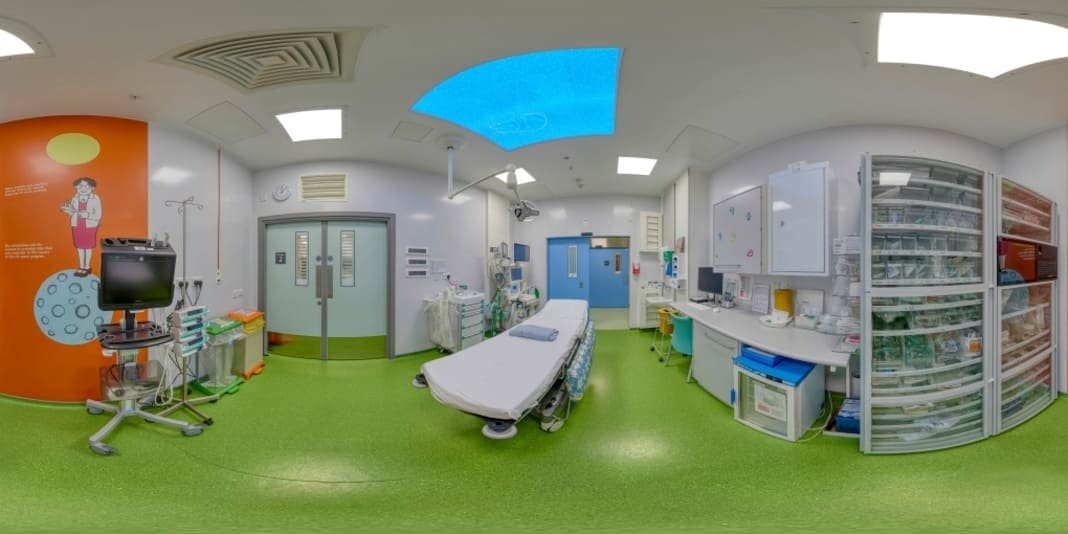
Bright atrium inside Evelina London Children’s Hospital with colourful lifts
Every child is different, so a personal assessment is the best next step. Ask a question
Questions parents ask me about baby birthmarks
Can I tell the type of birthmark from a photo?
A photo can show colour, size and position and a very goo idea but it cannot replace examination. I need to assess the birthmark and your child properly before giving a view on diagnosis or treatment.
Does a port wine stain go away on its own?
A port wine stain does not go away on its own. Laser treatment can fade selected port wine stains, although complete fading is often not possible.
What should I do if a haemangioma bleeds?
If an ulcerated haemangioma bleeds, British Association of Dermatologists guidance says gentle pressure with a clean cloth for 15 minutes often stops it. Seek medical help if bleeding continues.
Can a baby have laser treatment for a birthmark?
Some babies and children have laser treatment for selected birthmarks. The decision depends on the type of birthmark, the treatment aim, the child’s comfort and whether the child needs help staying still. There is a growing body of evidence to say that it is safe an defective in certain port wine stains.
Does every strawberry mark need medicine?
Every strawberry mark does not need medicine. A growing, ulcerated or well-placed haemangioma can need early assessment so the right treatment decision is made in time.
This is general information, not medical advice.
