Should my child have a mole removed?
A mole can worry you even when your child is perfectly well.
Removal is worth considering where a mole has suspicious features, causes symptoms, keeps catching or creates a genuine practical problem. Where examination supports it, monitoring is the better course, because surgery replaces the mole with a permanent scar. What settles it is an examination, not the way the mole looks in a photograph.
It is also worth saying plainly, because it is the thought most parents arrive with: melanoma is very rare in children. That does not mean a changing mole should be ignored, and it does not mean assessment is unnecessary. It does mean the odds are heavily in your child’s favour while you get it looked at.
Change needs interpreting, not acting on
A mole that has changed needs someone to work out what the change means. Growth is the obvious example: a mole on a growing child grows too, and that is expected rather than concerning.
The distinction that matters first is between a congenital mole, present at birth or appearing shortly afterwards, and an acquired mole that develops later in childhood. They behave differently and the evidence about one does not transfer to the other.
A specialist examines the mole using dermoscopy, a handheld magnifier with a specialised light that shows structures beneath the surface which the eye cannot resolve. NICE, which covers England, recommends dermoscopy for referred pigmented lesions, carried out by someone trained in it.
Features that tend to prompt closer assessment include:
- Pain, bleeding, or an area that has broken down on a congenital mole
- Growth that clearly outpaces your child’s own growth
- A new lump within the mole that feels unusually firm, or that keeps changing after it first appeared
- Repeated rubbing or catching that has become a practical nuisance
Assessment leads to one of three places: planned review, a biopsy taking a small sample for examination, or removal.
Your GP can look at a mole you are worried about and arrange an NHS referral where one is warranted. You can also book a private specialist consultation directly if you would rather not wait.
If you have noticed a mole or lump on your child, it is worth having it looked at. Arrange a consultation
Watching properly is not the same as waiting
Monitoring gets a bad name because it sounds like nothing happening. Done properly it is the opposite: a specialist examination, a documented starting point, and a review booked before you leave.
Baseline clinical photography records how the mole looks now. Dermoscopic photography records the detailed view through the magnifier. Together they turn a vague question about whether something has changed into a straightforward comparison.
NICE recommends exactly this for a clinically atypical mole that does not need removal at first assessment: baseline photography, ideally dermoscopic, and review after three months.
A stable mole with no symptoms is often best left, particularly where the scar would be more noticeable than the mole. Waiting also allows an older child to take part in a decision that is being made about their own body.
A few words from Miss Jana Torres-Grau
Photograph the mole against something for scale, and date it. Almost every difficult conversation about a child’s mole comes down to whether it has changed, and a dated photograph answers that in seconds.
What you gain, and what you are left with
Every removal decision is the same comparison: this mole, against the scar that replaces it.
The scar’s length and position depend on where the mole is, how big it is and how much nearby skin there is to close the gap. Miss Torres-Grau examines the mole, its position and the likely scar before recommending anything, because that comparison cannot be made from a description.
Removal is proportionate where a mole is causing symptoms or catching repeatedly. An appearance-led request needs the same scrutiny rather than less, precisely because the outcome is permanent.
The risks of congenital mole surgery include infection, a permanent scar, recurrence and mole tissue remaining behind. Where a scar crosses a site that moves a great deal, tightening can affect movement.
One thing worth knowing before assuming surgery is the safer option: removing a congenital mole does not remove all future risk, because naevus cells can remain afterwards, and melanoma has been reported even after extensive treatment.
A plan for this mole in this child.
Whether a local or general anaesthetic is used depends on the operation proposed, where the mole is, how big it is and how well your child would manage. A local anaesthetic numbs the area while they stay awake. A general anaesthetic means they are fully asleep. Age alone does not decide it.
Some small and medium congenital moles come out in one operation. Larger ones may need staging, because closing the wound requires enough nearby skin to work with. Removed tissue may go for histopathology, meaning examination under a microscope.
Laser deserves a word of caution. For congenital moles it generally lightens the pigment rather than removing the lesion, the colour can return, and it can leave pigment change or scarring of its own. It is not the scar-free alternative it sometimes appears to be.
Your child’s view counts, increasingly
Parents hold responsibility for decisions about their child’s care, and that does not change. What changes with age is how much weight a child’s own view carries alongside it.
Children and young people should be part of the discussion in a way that matches their maturity and understanding, and their view matters most where the mole is harmless and the reason for removing it is how it looks. A child who understands what a permanent scar means is entitled to an opinion about acquiring one.
A few words from Miss Jana Torres-Grau
Ask where the scar would sit and how long it would be before agreeing to removal. A scar you have pictured is far easier to weigh against a mole you already know.
The order the decision should happen in
Establish what the mole is doing. Then establish what removing it would achieve. Only then weigh that against the scar.
Taken in that order, most of these decisions become straightforward, and a good number of them end in observation. A specialist who is willing to tell you a mole is best left alone is giving you a clinical answer, not avoiding one.
This article gives general information. Only an examination can give a proper view of an individual child’s mole.
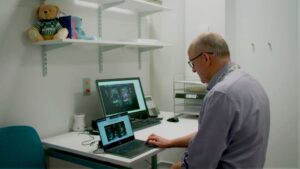
Specialist consultation room at Evelina London Children’s Hospital
A specialist can explain whether anything needs to be done. Ask a question
Common questions about childhood mole removal
Does a changing mole always need removing?
No. It always needs assessing. What follows might be a review in three months, a biopsy, or removal, and which of those applies depends on what the examination shows rather than on the fact that something changed.
Can a harmless mole wait until my child is older?
Often, yes. A stable mole with no symptoms can reasonably be monitored until your child is able to take part in the decision properly. The mole’s position and the likely scar still need assessing rather than assuming.
Will a removed mole be tested?
It may be. Removed tissue can be sent for histopathology, which is examination under a microscope, and whether that happens depends on why it was removed and what the examination found.
Can laser remove a congenital mole?
Not fully. Laser lightens the pigment rather than removing the lesion, the colour can come back, and it carries its own risk of pigment change and scarring. It is worth discussing, but not as a way of avoiding a scar.
Will my child need a local or general anaesthetic?
It depends on the mole and the operation rather than on their age. Site, size, what the procedure involves and how well your child would cope all feed into it, and it is one of the first things a consultation settles.
This is general information, not medical advice.
Reviewed by Miss Jana Torres-Grau, Consultant Paediatric Plastic Surgeon, FRCS (Plast), General Medical Council Specialist Register.
