Does your child need urgent care or a plastic surgeon’s review?
Urgent care or the emergency department treats your child first, and specialist review addresses complex repair, later healing concerns and scar management.
Urgent assessment through A&E is needed for multiple trauma, deep, gaping, heavily bleeding or facial wounds, serious bites, significant burns and or any associated with other injuries like head trauma (this is not an exhaustive list). Most childhood cuts heal well without a plastic surgeon. A paediatric plastic surgeon can assess injuries where accurate alignment, movement, nail growth, deeper structures or later scar behaviour need closer review.
Urgent treatment centres and A&E manage many cuts, grazes and straightforward fingertip injuries. Their role includes controlling bleeding, cleaning the wound and choosing a suitable closure method.
After urgent care, a specialist can assess complex repair, hand function, nail-bed damage, burn healing or a changing scar. An examination determines the right route for an individual injury.
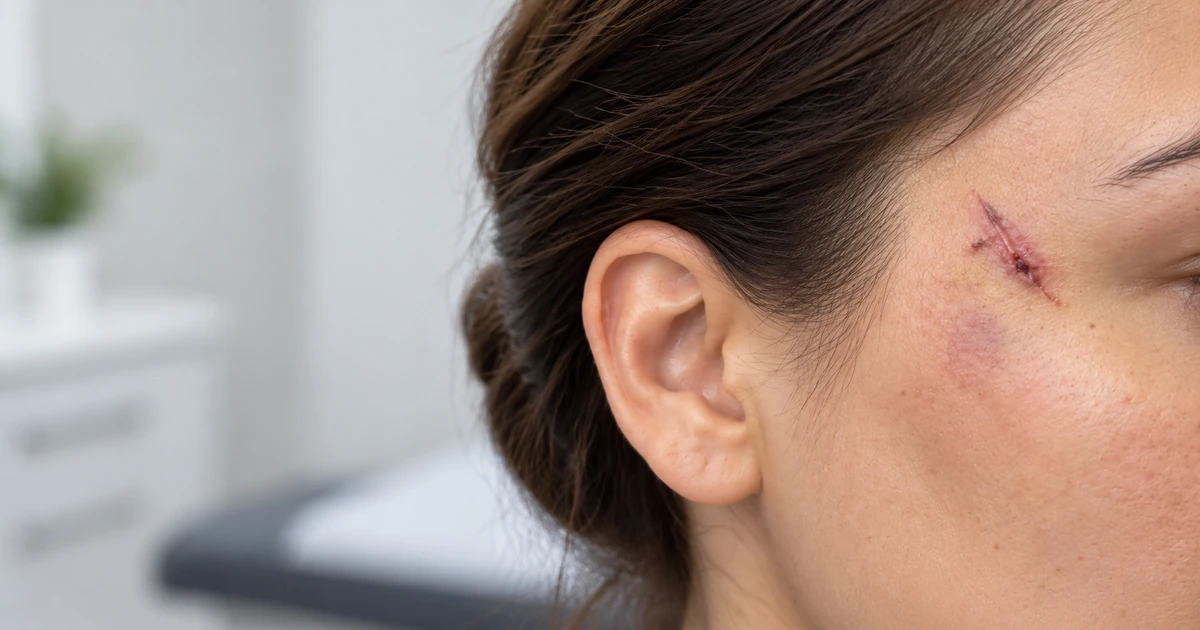
Emergency care closes many wounds, with closer assessment for complex repairs
Your child’s type of wound, depth, shape and position determine the closure method. Emergency clinicians use strips, glue or stitches according to the support the skin needs.
| Closure method | Best suited to | Where its limits appear |
|---|---|---|
| Adhesive strips | Small, shallow cuts where the skin edges sit together easily | They provide limited support for deeper wounds or wounds under tension |
| Skin glue | Selected small, straight cuts | It has less strength over moving areas or where wound edges pull apart |
| Stitches | Deeper, gaping or irregular wounds | They need skilled placement and removal where required |
Facial alignment matters when a cut crosses a visible boundary, such as the lip line or eyebrow. Prompt assessment allows the clinician to check the wound edges and decide how they should meet.
Depth also changes the repair. Visible yellow fat or dark red muscle suggests a wound extends beyond the surface skin and may need closure with stronger support. Staples are mainly used for selected scalp wounds and are generally avoided on the face.
If you have questions about your child’s care, you can arrange a consultation with Miss Jana Torres-Grau. Arrange a consultation
Burns need first aid first and specialist input for high-risk areas
First aid starts straight away. The Children’s Burns Trust sums it up as Cool, Call, Cover.
- Cool the burn under cool running water for 20 minutes. The NHS advises doing this as soon as possible, within three hours of the injury. Remove nearby clothing and jewellery unless it has stuck to the skin.
- Call 999 or go to A&E for a very large or deep burn, a facial burn, or a chemical or electrical burn. NHS 111 can guide you when you are unsure, and the Children’s Burns Trust advises medical help for any burn larger than a 50p coin.
- Cover the cooled burn by laying cling film over it, without wrapping it tightly around a limb.
There are national guidelines and process for certain types of burns. Burns in children, on the face, hands or over a joint will usually require discussion with a specialist burn service.
Hand injuries and dog bites can affect structures beneath the skin
A fingertip trapped in a door or window can injure the skin, the nail bed and the end bone of the finger. The nail bed is the tissue beneath the nail that supports nail growth.
A 2026 clinical review in the Journal of the Pediatric Orthopaedic Society of North America notes that emergency departments manage many straightforward fingertip injuries successfully. A paediatric hand-surgery team becomes relevant where the injury suggests damage beyond the surface wound.
- A torn or displaced nail, blood beneath the nail, skin loss or a fingertip fracture needs proper assessment.
- Urgent hospital assessment is the right route for substantial tissue loss, a partial amputation, or a suspected tendon, nerve, blood-vessel or bone injury.
- After a dog bite to the hand or face, a clinician checks the wound depth, tissue damage, contamination and signs of infection.
- Get prompt medical advice if increasing pain, inflammation, fever, discharge or an unpleasant smell develops after a bite.
NICE, which covers England, recommends hospital referral for a penetrating bite involving or near an artery, joint, nerve, muscle, tendon, bone or the central nervous system.
A few words from Miss Jana Torres-Grau
Cool a child’s burn under cool running water for 20 minutes, then cover it loosely with cling film. Seek medical help for a burn larger than a 50p coin.
Further specialist review can address healing, scars and best function.
A wound that has already been closed can still benefit from a later specialist review. Healing continues after the initial repair, and a review can focus on scar thickness, skin movement and function. In certain cases if there is doubt of internal structure damage (for example in the hand) that can also be addressed.
Movement needs closer attention when a scar crosses an area that bends and begins to restrict it.
Scar change can also prompt assessment. A hypertrophic scar stays within the original wound and becomes raised or thick. A keloid extends beyond the original wound edges.
Scar planning aims to improve how a scar heals and behaves. Treatment cannot remove every trace of an injury or return skin to its pre-injury appearance.
Miss Torres-Grau sees children in London for this later review. She assesses each child herself and explains the care route directly to you.
A few words from Miss Jana Torres-Grau
Keep any discharge letter or treatment notes after a fingertip injury. These help a later reviewer see how the injury was first treated.
Common questions about childhood injuries and plastic surgery
Does a cut on my child’s face need a plastic surgeon?
Sometimes, when an assessment shows the cut needs precise repair. Facial cuts need prompt professional assessment when they are deep, gaping, heavily bleeding or irregular.
Can A&E use glue on a child’s facial cut?
Yes, A&E can use skin glue for a few selected small, straight wounds. Glue has limited strength over moving or tense areas, so the wound itself determines whether glue, strips or stitches provide the right support.
Does a nail-bed injury need surgery?
Sometimes, an assessment shows whether the nail bed needs repair. Emergency departments manage many of these injuries. A paediatric hand-surgery team becomes involved with substantial tissue loss, a displaced fracture or damage to deeper structures.
Should a dog bite on a child’s face be seen urgently?
Yes. A bite to the face or hand needs prompt assessment for depth, tissue damage, contamination and infection. Urgent care is particularly important where the bite penetrates deeply or infection symptoms develop.
Can a plastic surgeon review stitches put in somewhere else?
Yes. A later specialist review can assess wound healing, scar thickening, scar enlargement and movement across the healed area. Scar treatment aims to improve the scar’s behaviour and function.
This is general information, not medical advice.
Reviewed by Miss Jana Torres-Grau, Consultant Paediatric Plastic Surgeon, FRCS (Plast), General Medical Council Specialist Register.
Every child is different, so a personal assessment is the best next step. Ask a question