What is the difference between otoplasty and pinnaplasty for your child?
If you have read one clinic page saying otoplasty and another saying pinnaplasty, they may be describing the same ear pinning operation. Otoplasty is also used more broadly for ear reshaping. For a child, the useful decision comes from examination, ear shape, timing and the child’s own view.
I will explain the terms, the age points for babies and children, what surgery involves, and the risks and recovery parents should know about before any decision is made.
The terms overlap in everyday use
Otoplasty and pinnaplasty often overlap in normal clinic language. The most useful distinction is that otoplasty can mean ear reshaping more broadly, and pinnaplasty is commonly used for pinning prominent ears closer to the head.
NHS.uk says ear correction surgery can alter ear size or shape, or pin ears back, and it describes pinning back the ears as “an otoplasty or pinnaplasty”. Its ear correction surgery page was last reviewed on 22 September 2023.
| Term | What it often means | What parents should understand |
|---|---|---|
| Otoplasty | Ear reshaping surgery, including ear pinning | The word can cover changes to ear shape, size or position |
| Pinnaplasty | Surgery to pin prominent ears closer to the head | Children’s patient information often uses this word for prominent ear correction |
| Ear pinning | A plain-language term for setting ears closer to the head | It describes the aim, but it does not describe the exact surgical plan |
A referral, website or leaflet may use one word rather than another, but the label does not tell you whether surgery is suitable for your child. It also does not tell you whether one ear or both ears would be involved, or which part of the cartilage is shaping the ear position.
If you have questions about your child’s care, you can arrange a consultation with Miss Jana Torres-Grau. Arrange a consultation
The assessment decides what ear correction means
Two children can both be described as having prominent ears, but the reason can be different. One child may have a missing cartilage fold. Another may have an ear bowl that sits further forward. A third may have one ear that differs from the other.
During a prominent ear assessment, I look at the ear anatomy directly. I examine the cartilage shape, the fold of the ear, the position of the ear bowl and any asymmetry between the two sides. I also listen to your child’s own view, because appearance-led surgery in a child should never be driven by adult worry alone.
For families seeing Miss Jana Torres-Grau in London, the consultation is also where I explain when surgery is not the right step. Prominent ears can be a normal feature. A clear assessment gives the term, otoplasty or pinnaplasty, its proper meaning for that individual child.

A few words from Miss Jana Torres-Grau
Use the consultation to compare the ear fold, ear bowl and side to side symmetry. Those details often matter more than the label otoplasty or pinnaplasty.
The right timing differs for babies and children
Timing changes the answer because a baby’s ear cartilage behaves differently from an older child’s cartilage. The same concern, prominent ears, can therefore lead to different options at different ages.
- Babies: NHS.uk says ear splints can be used for babies with prominent ears before 6 months, because the ear cartilage is still soft. Splints are a non-surgical option, and suitability depends on assessment.
- Younger children: Ear pinning surgery is not suitable for children younger than 5, according to NHS.uk. At that age, the ears are still growing and the cartilage is too soft to hold stitches well.
- Older children: Once a child is older, the question becomes more individual. I look at the anatomy, how well a child could manage aftercare, and whether the child has their own settled view about surgery.
Age alone does not decide the plan. The word on the page does not decide it either.
The surgery, risks and recovery need plain explanation
Whichever term is used, the practical questions are what is done during surgery, what risks exist and what care is needed afterwards. Parents need that explained plainly before deciding whether paediatric otoplasty or pinnaplasty is the right discussion to have.
The operation itself
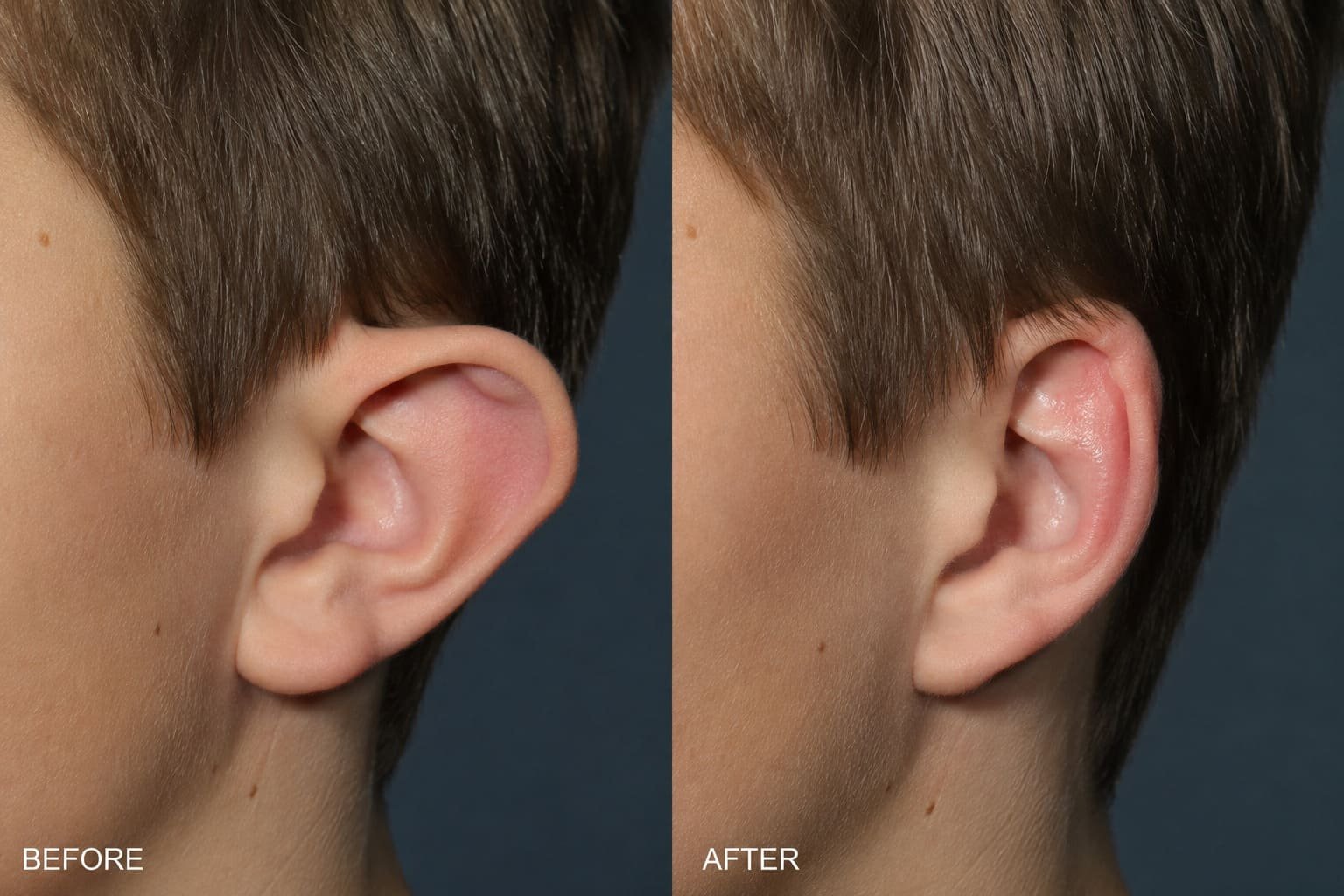
Children’s pinnaplasty is commonly described as surgery under general anaesthetic, which means medicine keeps the child asleep during the operation. Evelina London Children’s Hospital patient information, published July 2026, describes the procedure as involving a small cut behind each ear, reshaping, folding or removing cartilage, and stitches behind the ears.
That description matters because ear correction surgery is a structured operation on cartilage. It is not a simple change in wording from “prominent ears” to “pinned back ears”.
Implant insertion for prominent ears is a separate point. NICE HTG526 says the evidence on safety and efficacy is inadequate in quality and quantity, so the procedure should only be used in research. I would not present implant-based correction as standard children’s ear correction.
The risks to discuss
Every operation carries risk. For children’s pinnaplasty, the risks listed in Evelina London Children’s Hospital patient information include infection, bleeding, a blood clot in the skin of the ear, inflammation of the ear cartilage, scarring, stiff ears, temporary numbness or tingling, asymmetry, and the ears starting to stick out again. The same leaflet also lists rare loss of skin or cartilage inside the ear.
Risk discussion is part of good care, not a formality. I go through what those risks mean in practical terms and how they apply to the operation being considered.
The recovery at home
Aftercare affects the timing decision because a child has to manage dressings and activity limits. Evelina London Children’s Hospital patient information says a child usually wears a head bandage for 7 to 10 days after pinnaplasty, then a soft headband at night for 6 to 8 weeks.
Swimming is avoided for 6 weeks, and contact sports or rough play are avoided for 3 months. A child can usually return to school after the head bandage has been removed and they have been seen in dressing clinic. Those details are practical, and they are part of deciding whether the time is right.
A few words from Miss Jana Torres-Grau
If a baby is under 6 months, mention the age early in the enquiry. Ear splints are only relevant in that early period, so timing affects the options discussed.
The useful takeaway for parents
Once the words are clear, the decision becomes easier to judge. You do not have to work out whether otoplasty or pinnaplasty is the “correct” word before you speak to a surgeon. You need to know what the word means in your child’s case.
With Miss Jana Torres-Grau, I assess each child myself and explain the anatomy, the timing, the options and the reasons for or against surgery. I carry that same view through from the first consultation to follow-up, so the advice is based on the child in front of me rather than a term on a leaflet.
The shift is simple. You start with two confusing words, and you end with specific things to check: what part of the ear is involved, whether the timing is right, what your child thinks, and whether surgery has a clear reason.
Every child is different, so a personal assessment is the best next step. Ask a question
Questions parents ask me about otoplasty and pinnaplasty
Is pinnaplasty the same as ear pinning?
Yes, pinnaplasty is commonly used to mean ear pinning surgery, especially for prominent ears. It usually refers to surgery that sets the ears closer to the head.
Is otoplasty the medical name for ear pinning?
Otoplasty is often used for ear pinning, but it can also mean wider ear reshaping surgery. That is why the assessment matters more than the word used.
Can babies have prominent ears corrected without surgery?
Babies may be considered for ear splints before 6 months, when the ear cartilage is still soft. An assessment is needed to decide whether splints are suitable for an individual baby.
Can otoplasty be done on one ear only?
Ear correction can involve one ear or both ears, depending on the anatomy and the concern being assessed. The consultation looks at symmetry, cartilage shape and what change is realistically being considered.
How much is a consultation about children’s ear correction?
A consultation with Miss Jana Torres-Grau is £250. The consultation is where I examine your child, explain what I find and discuss whether any treatment is appropriate.
This is general information, not medical advice.
