Can newborn ears be reshaped without surgery?
A folded or uneven ear is often noticed within days of birth, and many parents have no idea a non-surgical option exists.
Ear splinting, also called ear moulding, uses a fitted device to hold the visible outer ear in a planned position while newborn cartilage is still soft enough to be guided. It treats selected differences in ear shape, and whether it suits a particular baby depends on what the ear difference is, which takes an examination to establish.
What follows covers the timing, which ear shapes may be suitable, what treatment involves, and what it cannot do.
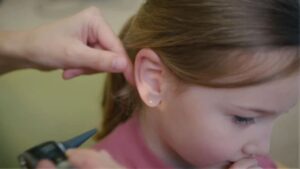
Child receiving ear care at Evelina London Children’s Hospital.
The first weeks matter more than any deadline you have read
Newborn ear cartilage is at its most flexible in the first weeks of life, which is why early assessment is worth arranging rather than waiting to see.
A 2024 systematic review in Facial Plastic Surgery & Aesthetic Medicine pooled 37 studies covering 3,341 patients. The average starting age was 4.8 weeks and the average treatment duration was 5.1 weeks. Those studies used different starting ages, different devices and different ways of judging results, which is worth knowing before treating any single figure as a rule.
The six-week deadline that circulates online is a rough guide rather than a cut-off. What actually determines the plan is the ear’s anatomy, the age at fitting, how the ear responds and which technique is used. If your baby is already past six weeks, that is a reason to get an opinion quickly rather than to assume you have missed the chance.
If you have questions about your child’s care, you can arrange a consultation with Miss Jana Torres-Grau. Arrange a consultation
What the ear difference is also decides whether moulding can work
A congenital auricular deformity means the visible outer ear has formed with an atypical shape, fold or position. Auricular simply means relating to the outer ear.
The shapes that come up most often are a prominent ear, sitting further from the head than usual; a lop or cup ear, with the upper part folded over; Stahl’s ear, with an extra fold of cartilage; a helical rim deformity, affecting the curved outer edge; and cryptotia, where the upper ear sits partly buried beneath the skin at the side of the head.
The question underneath all of them is the same: is there cartilage present that can be guided into a different shape?
| What an assessment may find | What ear splinting can do | Why this distinction matters |
|---|---|---|
| A fully developed outer ear with an atypical fold, rim or position | A fitted device may guide the existing cartilage into a planned shape | Moulding may suit the anatomy that is already there |
| Absent or substantially underdeveloped ear tissue | Splinting reshapes cartilage that exists, and cannot create tissue that does not | Reconstructive options need a separate conversation entirely |
Some newborn ear-shape differences settle by themselves as a baby grows. Nobody can tell you from a photograph whether yours will, which is the practical argument for having it looked at rather than watching and hoping.
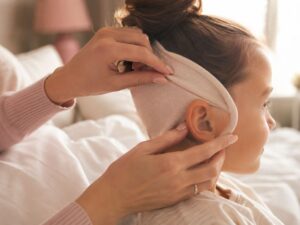
Soft Headband Support After Child Ear Correction Procedure – Illustrative Image
A few words from Miss Jana Torres-Grau
Check the skin around the device every day rather than at review appointments only. Soreness, swelling, discharge or broken skin all need a call to the team, and catching them early is usually the difference between adjusting a device and abandoning treatment.
Fitting is straightforward, monitoring is the important part
The mould supports the outer ear in a planned position over a period of weeks. The process runs like this:
- The outer ear is examined, including its folds, rim and position.
- A moulding device is fitted to hold the cartilage where it is meant to go.
- Review appointments check both the fit and the condition of the skin underneath.
- The mould is adjusted, replaced or removed depending on how the ear is responding and how the skin looks.
How long it takes follows the baby rather than a timetable. Devices frequently need adjusting partway through, particularly where the ear position or the skin calls for it.
The 2024 review found no significant difference in correction or complication rates between devices made up by a clinician and commercial systems. The device brand matters considerably less than the fitting and the monitoring.

Reassuring Support During Child Ear Correction Recovery – Illustrative Image
Skin checks, and what results can honestly be promised
Non-surgical does not mean unsupervised. Something is adhered to a newborn’s skin for several weeks, and that skin needs watching.
Local skin problems need prompt review
Adhesive reactions, skin irritation, skin breakdown, swelling, discharge, ulceration and infection can all occur around the device or the adhesive.
Contact the clinical team if you see any of them. Soreness, redness, swelling, any discharge, or skin that looks broken or damaged all warrant a call rather than waiting for the next scheduled review. The team can decide whether the device needs adjusting, refitting or taking out, and getting that decision early is what stops a minor skin problem becoming a reason to abandon treatment.
A 2024 meta-analysis in the International Journal of Pediatric Otorhinolaryngology found that reported adverse effects were mainly local skin problems, with rates varying between studies and devices.
No guarantee but the evidence supports a discussion
Results differ between ear shapes and between babies. Pooled figures give useful context and cannot predict what will happen for one child.
A 2025 cohort in Plastic and Reconstructive Surgery Global Open found treated ear shapes generally remained improved more than six years afterwards. It followed patients from a single surgeon’s practice with limited long-term photography, so it is encouraging rather than conclusive.
Otoplasty, surgery to change the shape or position of the outer ear, remains available later where moulding does not achieve what was discussed at the outset. Splinting is not a guarantee of avoiding it.
A few words from Miss Jana Torres-Grau
Do not screen your baby out on age alone. The published average start is around five weeks, but ear shape, cartilage and skin condition decide suitability, and an assessment settles in one appointment what an online age cut-off cannot.
What an assessment actually establishes
Four things: whether the outer ear anatomy is suitable for splinting, how much reshaping is realistically achievable, how the skin would be monitored, and whether the ear tissue present means a reconstructive conversation is the more appropriate one.
Miss Torres-Grau assesses each baby herself in London and explains in plain terms what is achievable, including when moulding is not the right answer. A normal variation in ear shape does not have to be treated, and being told that is a legitimate outcome of an assessment.
The useful question is not whether newborn ears can be reshaped in general. It is whether this baby’s ear can be, safely and realistically, and that has a clear answer available within days.

Every child is different, so a personal assessment is the best next step. Ask a question
Common questions about ear splinting for babies
Is six weeks too late for baby ear moulding?
Not necessarily. The first weeks offer the best opportunity, but the six-week figure is an average from the research rather than a cut-off. Have the ear looked at, since the anatomy may still be suitable.
How long do newborn ear moulds stay on?
It varies with the age at fitting, the ear shape, how it responds and how the skin copes. The average across the published studies was around five weeks, and your own review appointments decide when the device comes off.
Will my baby’s folded ear develop naturally?
Some do settle on their own. Which ones is not something anyone can predict from an appearance, and waiting to find out uses up the weeks when moulding works best.
Can ear moulding affect hearing?
Moulding treats the shape of the outer ear, not hearing. The device does sit near the ear canal, so its position is part of what gets checked at fitting and review.
What should I do if the skin looks sore during treatment?
Ring the clinical team rather than waiting for the next appointment. They can look at the fit and decide whether the device needs adjusting or removing, and skin problems are much easier to deal with early.
This article gives general information. An individual assessment gives a proper view of whether ear splinting is suitable for a particular baby.
This is general information, not medical advice.
Reviewed by Miss Jana Torres-Grau, Consultant Paediatric Plastic Surgeon, FRCS (Plast), General Medical Council Specialist Register.