What age can your child have ear correction surgery?
Usually from age 8. That is the point at which the ears are nearly fully developed and the cartilage is firm enough to hold surgical stitches securely, and it is the age given in current Evelina London Children’s Hospital information.
It is a starting point rather than a recommendation. Whether surgery is right for a particular child depends on how their ears have developed, what the child themselves wants, and whether they can cope with the dressings, the restrictions and the weeks that follow.
Prominent ears are a normal variation rather than a problem requiring correction, and plenty of children never want anything done about them.

Why age 8, and why it is not a rule
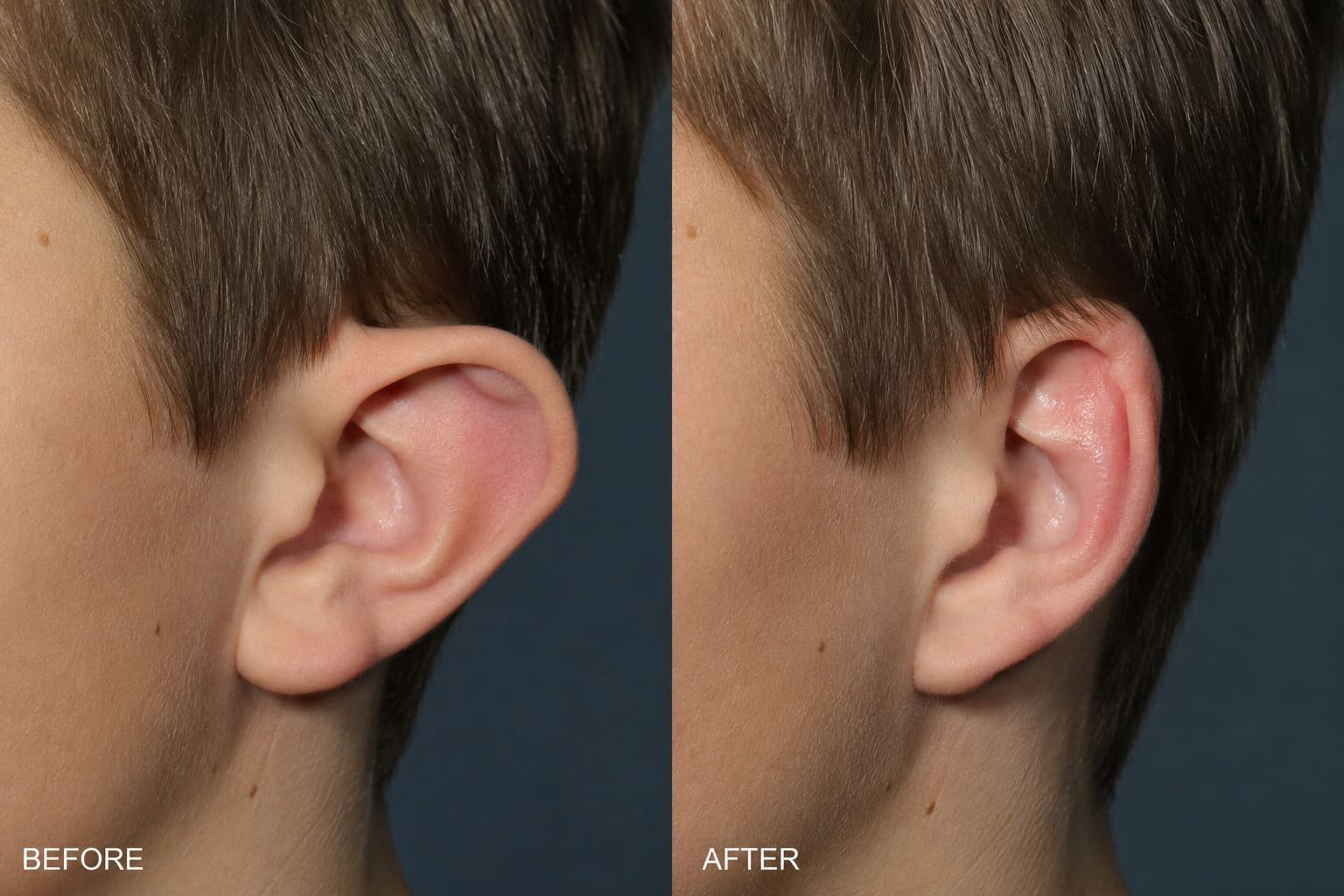
Pinnaplasty, also called otoplasty or ear pinning, reshapes prominent ears and brings them closer to the head.
Younger ears are still growing, and younger cartilage tends to be too soft to hold stitches reliably, which is the practical reason for waiting. By around eight the ears are close to their adult size and the cartilage behaves predictably under surgery.
Reaching that age means an assessment becomes worthwhile. It does not mean surgery is indicated, and the two questions are genuinely separate. Furthermore a younger child may benefit for an assessment too.
| Your child has reached age 8 | Your child is ready for surgery |
|---|---|
| The ears are likely to be developed enough for the cartilage to hold stitches | An examination confirms that the ear shape and cartilage suit the operation being proposed |
| An assessment becomes a reasonable thing to arrange | Your child has had the procedure explained and can say what they think about it |
| You can start the conversation | Your child wants it, rather than agreeing to it |
| Age tells you when to ask the question | Readiness tells you what the answer is |
Nor is eight a deadline. Teenagers are assessed for this operation routinely, and nothing closes off by waiting.
If you have questions about your child’s care, you can arrange a consultation with Miss Jana Torres-Grau. Arrange a consultation
Whether your child wants it carries real weight
This is appearance-led surgery on a child, which puts the child’s own view close to the centre of the decision rather than at the edge of it.
The General Medical Council is explicit: children should take part in decisions about cosmetic interventions as much as they possibly can, and where a clinician judges that the child does not want the procedure, it must not be performed. That is a limit on what any surgeon can do, regardless of what a parent wants.
Raising the subject and arranging an assessment is entirely reasonable for a parent. What follows has to leave the child room to say what they actually think, without feeling that a decision has already been made for them. This is also why older children are more suitable, they are more able to express their views.
What the assessment is looking at
Two things at once, physical suitability and readiness.
On the physical side, an examination covers the shape of the ears, the state of the cartilage and whether the child could realistically manage the dressings and restrictions afterwards.
On readiness, what matters is whether the operation has been explained in terms your child actually follows, whether they have had a proper chance to ask questions, and whether their answer is their own.
Miss Torres-Grau assesses each child herself and talks through the hoped-for result, what surgery can and cannot achieve, and the situations where waiting, or doing nothing at all, is the better course.
A few words from Miss Jana Torres-Grau
Work backwards from the school calendar. Seven to ten days in a bandage, six weeks without swimming and three months without contact sport all sit better in some terms than others, and the operation date is easier to move than the school year.
What the operation and the months afterwards involve
Timing is not only about the operation date. It is about whether the weeks that follow fit around school, activities and what your family can manage at home.
Children have a general anaesthetic, meaning they are asleep and feel nothing throughout.
- The surgeon makes a cut behind each ear.
- Cartilage is reshaped, folded or partly removed.
- Stitches hold each ear in its new position.
- Your child wakes and recovers before going home.
The operation can take up to two hours, and many children go home the same day once they are comfortable, eating and drinking, not vomiting and behaving like themselves.
Then comes the part worth planning around. A head bandage stays on for 7 to 10 days, with a dressing review during that period, and school usually restarts after it. A soft headband is then worn at night for 6 to 8 weeks. Swimming is out for 6 weeks and contact sports and rough play for 3 months.
Set an operation date against the school calendar and against what is happening at home, rather than taking the first one offered.

What surgery can and cannot deliver
Every operation carries risk. For pinnaplasty that means bleeding, infection, and a collection of blood in the ear called a haematoma. Cartilage inflammation, scarring and stiffness are recognised too, along with temporary numbness or tingling.
The limits are worth stating as plainly as the risks. Ears are not identical on anybody, and no operation produces a matched pair. What surgery aims at is better position and shape, not symmetry, and a family expecting the second will be disappointed by a perfectly good result.
Ears can also start to protrude again afterwards, and further surgery is sometimes considered where that happens.
Miss Torres-Grau goes through the risks, the likely recovery and the realistic result for the specific operation proposed, alongside your child’s health and their ability to follow the aftercare.
A few words from Miss Jana Torres-Grau
Ask your child what they think while you are still deciding, not after the appointment is booked. Their answer is part of the clinical decision, and a surgeon should not proceed with a child who does not want it.
Waiting does not close anything off
Some children benefit from more time, simply because a year makes a considerable difference to how well an eight-year-old understands what is being proposed and how much they can contribute to deciding it.
Parents tend to fixate on the earliest possible age because they assume delay costs them the option. It does not. Ear correction surgery can be assessed at any point through childhood and into the teenage years.

Every child is different, so a personal assessment is the best next step. Ask a question
Common questions about ear correction surgery
Is 5 too young for otoplasty?
Usually, yes. Current Evelina London Children’s Hospital information puts pinnaplasty from age 8, because younger ears are still growing and the cartilage is often too soft to hold stitches securely.
Can a teenager still have ear correction surgery?
Yes. Age 8 is a rough starting point rather than an upper limit, and teenagers are assessed on ear shape, their own wishes, their understanding and their ability to manage the aftercare, exactly as younger children are.
Will my child have a general anaesthetic?
Yes. They will be asleep for the operation and will feel nothing during it.
How long will my child need to be away from school?
Around 7 to 10 days. The head bandage stays on for that period, there is a dressing review, and school usually restarts afterwards.
Can ears stick out again after surgery?
They can. It is a recognised outcome rather than a rare disaster, and further surgery may be considered if it happens.
Does my child need to wear a headband at night?
Yes, once the main bandage is off, for 6 to 8 weeks. Your surgical team will give instructions specific to your child’s recovery.
This article gives general information. Only an examination can give a proper view of an individual child.
This is general information, not medical advice.
Reviewed by Miss Jana Torres-Grau, Consultant Paediatric Plastic Surgeon, FRCS (Plast), General Medical Council Specialist Register.